
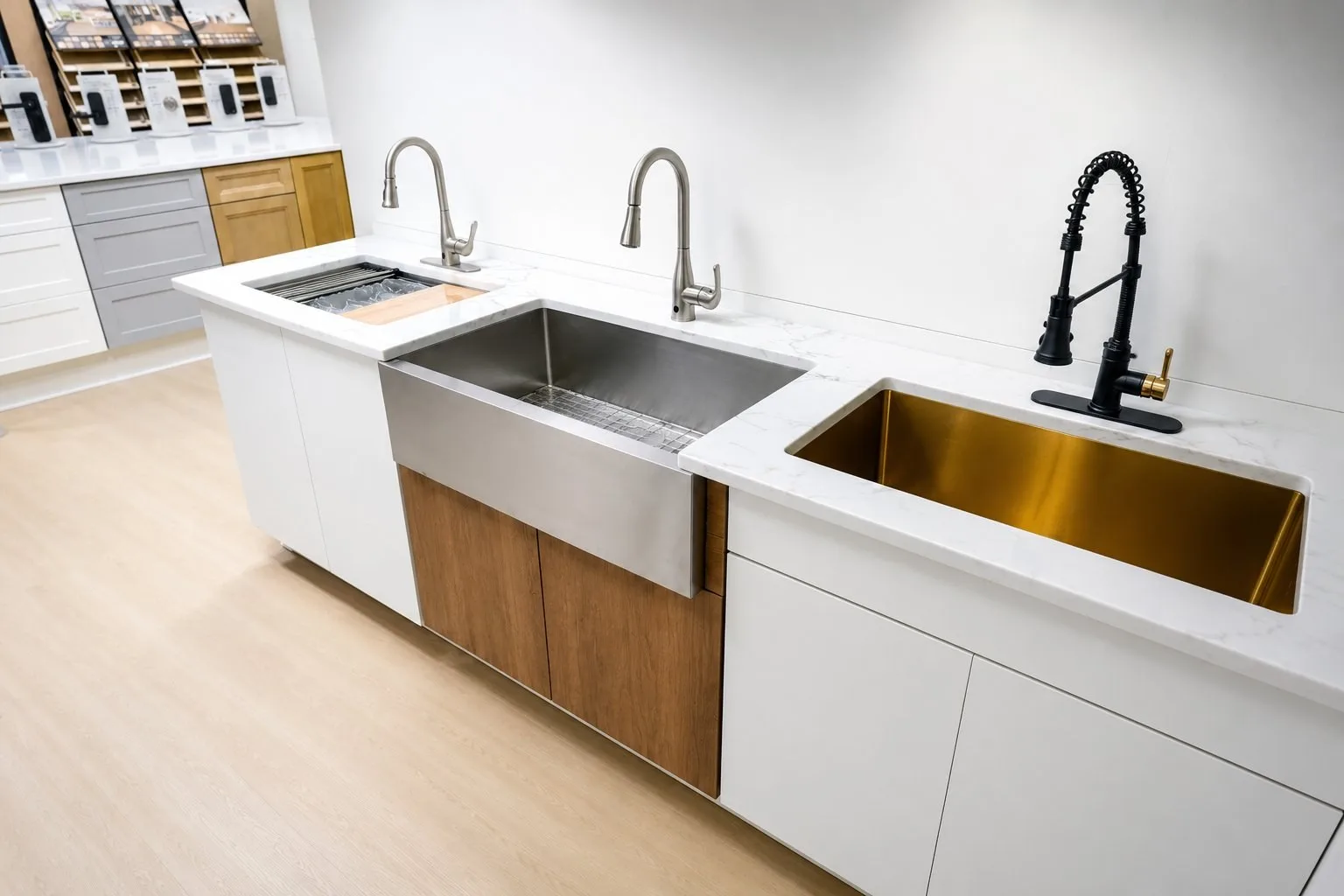
Ask ten kitchen owners which countertop is "best" and you'll get ten confident answers — usually for whichever one they already own. The honest truth is simpler: quartz, granite, and porcelain each win on something different. The right one for your kitchen depends on how you cook, how much maintenance you'll actually do, and what look you want to live with.
Here's the comparison we walk through in our Revere showroom, without the sales pitch.
Quartz: the low-maintenance workhorse
Quartz countertops are engineered stone — natural quartz crystals bound with resin and pigment. That engineering is the whole point:
- Stains barely stand a chance. Quartz is non-porous, so coffee, wine, and tomato sauce wipe up instead of soaking in. No sealing, ever.
- The pattern is predictable. Because it's manufactured, the slab you approve is very close to what gets installed — no surprise veining you didn't expect.
- It's tough, with one caution. Quartz handles daily use well, but it doesn't love extreme heat. A hot pan straight from the stove can damage the resin, so trivets are a real habit, not a suggestion.
- Edges and sinks are flexible. Undermount sinks, waterfall edges, and integrated drainboards are all straightforward in quartz.
Quartz is the right call when you want a kitchen that looks good with the least upkeep — especially for busy families and rental kitchens, where the next person won't maintain a sealing schedule. We carry MSI quartz countertops in the showroom for exactly that reason.
Granite: natural stone, one of a kind
Granite is cut from the earth, and every slab is genuinely unique. If you want a countertop nobody else has, this is the only one of the three that can honestly promise it.
- Heat is not a worry. A hot pan on granite is a non-event — it's stone, formed under heat and pressure.
- The look is the selling point. Deep veining, movement, and color variation that no factory fully reproduces. Choose your exact slab in person, because two slabs of the same granite name can look quite different.
- It needs sealing. Granite is porous, so it needs a sealer when installed and re-sealing on a schedule after that. Skip the schedule and stains become a real risk, especially around the sink and stove.
- Seams show on big runs. Large kitchens and long islands need seams, and in busy patterns they can be visible. A good fabricator places them where your eye doesn't land.
Granite is the right call when you love natural variation, you cook with high heat, and you'll keep up with sealing — or you're fine asking us to remind you when it's due.
Porcelain: the new contender
Porcelain slabs are made by sintering fine clays and minerals at very high temperatures — the same process as high-end tile, scaled up to full countertop slabs.
- Heat, scratches, and stains all bounce off. Porcelain is the most resistant of the three to all three. Hot pans, knife work, red wine — none of it fazes the surface.
- Big slabs, minimal seams. Porcelain comes in large formats, so long runs and full-height backsplashes can go nearly seamless, and the same slab can wrap from counter to backsplash to wall.
- It's thin and light. That opens up options the heavier stones don't offer as easily, including cladding and outdoor kitchens.
- Edges need care. The trade-off: porcelain can chip at exposed edges if it's struck hard, and fabrication takes real experience — not every shop cuts it well. Who fabricates it matters more here than with the other two.
Porcelain is the right call when you want the hardest-wearing surface and a modern, seamless look, and your fabricator has real porcelain experience.
At a glance
- Lowest maintenance: quartz — no sealing, wipe-and-go.
- Best heat resistance: granite and porcelain — hot pans welcome.
- Most stain-resistant: quartz and porcelain — both non-porous.
- Most unique look: granite — no two slabs alike.
- Most seamless look: porcelain — large formats, minimal joints.
- Most predictable look: quartz — what you approve is what arrives.
How to choose for your kitchen
Start with your habits, not the sample wall:
- How do you cook? Daily high-heat cooking leans granite or porcelain. Mostly reheating and prep leans quartz.
- Will you seal on schedule? Be honest. If the answer is "probably not," cross granite off or plan for us to handle the schedule with you.
- What are your cabinets? Counters and cabinets are one visual decision. Bring a cabinet door or finish sample when you shop counters — at our showroom, the quartz and granite sit in the same room as the cabinets deliberately, so the combination you see is the combination you get.
- Look at full slabs, not phone photos. Veining, scale, and color shift in real light. Stand in front of the real thing before you commit.
There is no wrong answer among the three — only a wrong match for how you live. And whichever you choose, installation is managed and coordinated through approved contractors, designers, and architects, so the fabrication and fit are handled by people who do this every day.
See them side by side before you buy
That's the whole philosophy of our showroom. Compare quartz, granite, and porcelain samples side by side, next to your cabinet finish, plan your layout with our team, and preview directions with our AI visualizer using a photo of your own kitchen — all before you spend anything. Consultations are free. Book a free consultation.
Boston Home Solutions — Kitchens. Baths. Floors. One Local Showroom.
30 Revere Beach Pkwy, Revere, MA 02151 · 781-810-4747 · Mon–Fri 10 AM–6 PM, Sat 10 AM–2 PM · Outside hours by appointment.