
Most cabinet mistakes happen before anyone touches a tool. A finish that looked perfect on a phone screen shows up different in real light. A layout that measured "close enough" leaves a drawer that can't open past the fridge. Cabinets are the biggest single piece of most kitchen budgets, and they're the piece you live with longest — so this is the purchase worth slowing down for.
This guide walks through what actually matters when you choose kitchen cabinets: construction, style, finish, layout, and the questions to ask before you spend anything. It's the same walk-through we do in our Revere showroom every week.
Start with construction, not color
The door style is what you see; the box is what you live with. Before you fall for a finish, check what's underneath it:
- The box. Plywood construction is the workhorse standard — strong, stable, and holds screws well. Particleboard and MDF boxes cost less and can be fine in dry, low-stress spots, but they don't forgive water or heavy loads the way plywood does.
- The drawers. Look for solid-wood drawer boxes with dovetail joints and full-extension, soft-close glides. A drawer you can pull all the way out, loaded with pots, without a wobble is worth more than any upgrade knob.
- The hinges. Soft-close, six-way adjustable hinges are what separate a kitchen that feels solid at year ten from one that feels tired at year two.
- The finish. A factory finish — baked, catalyzed, applied in controlled conditions — outlasts a site-applied paint job in a working kitchen. If you're choosing painted cabinets, this matters most in white and light colors, where wear shows first.
Styles: Shaker still runs Greater Boston
Trends come and go, but in the homes we see across Revere, Everett, Chelsea, and Malden, one style outsells everything else for a reason: Shaker. Its clean, recessed-panel frame works in a triple-decker rental, a colonial in Saugus, and a new condo in East Boston without fighting the house.
Beyond Shaker, the honest shortlist:
- Flat-panel (slab) — modern, minimal, easy to wipe down; shows fingerprints more, especially in dark finishes.
- Raised-panel — traditional and warm; suits older homes with detailed trim.
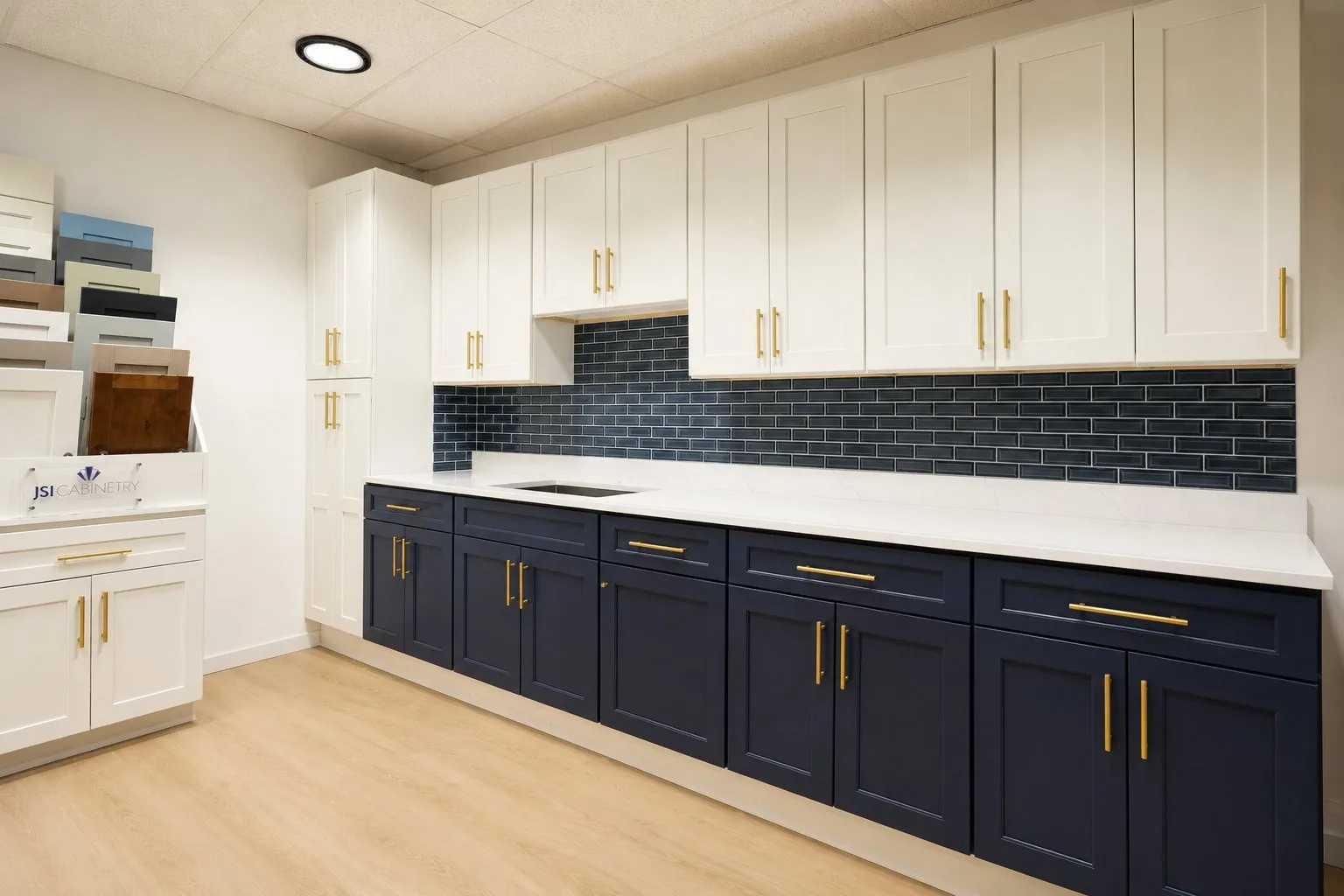
- Two-tone — a darker island or lower cabinets with lighter uppers adds depth without committing the whole room to a bold color. Our own showroom display pairs white uppers with a navy base for exactly this reason.
Whatever you choose, choose it standing in front of a full-size door, in daylight and in warm light — not from a two-inch sample photo online.
Plan the layout before the cabinets
Cabinets don't fail kitchens; layouts do. Before you order a single box:
- Measure twice, honestly. Wall to wall, floor to ceiling, and every obstacle: windows, radiators, bulkheads, door swings. Bring those measurements — or just good photos — to your consultation and we'll work through the layout with you.
- Protect the work triangle. Sink, stove, and refrigerator should form a triangle you can move through without crossing the room.
- Count storage by what you own. Deep drawers beat deep cabinets for pots and small appliances. A trash pull-out and a tray divider cost little at planning time and pay off daily.
- Decide on the countertop at the same time. Cabinets and counters are one visual decision. At our showroom, the quartz and granite are in the same room as the cabinets deliberately — the combination you see is the combination you get.
Stock, semi-custom, or custom?
- Stock cabinets come in standard sizes, ship fast, and cost the least. Best when your kitchen fits standard dimensions and your timeline is tight.
- Semi-custom adds sizes, finishes, and modifications — the right middle ground for most remodels.
- Full custom is built to the inch. It's the answer for unusual spaces, and the budget should match that expectation.
We carry JSI Cabinetry in the showroom because it covers the first two categories well — the value most Greater Boston homeowners and landlords are actually looking for: solid construction, current styles, and lead times a real project can live with.
For landlords and contractors: cabinets that survive tenants
We come from real estate and development ourselves — 20+ years of it — so we'll tell you plainly what we'd put in our own rentals: durable factory finishes over delicate ones, Shaker or slab doors that are cheap to replace one at a time, and hardware that doesn't loosen. A rental kitchen doesn't need to be expensive. It needs to look good at move-in and still look good at the next turnover.
Five questions to ask any cabinet seller
- What is the box made of — and can I see a cutaway or a real cabinet, not a rendering?
- Are the drawers dovetailed, and are the glides full-extension soft-close?
- Is the finish factory-applied?
- What is the real lead time — and what happens to my project if it slips?
- Who coordinates the installation, and who do I call if something arrives damaged?
Any showroom that can't answer those five in plain language is asking you to take the risk for them.
See them in person before you buy
That's the whole philosophy of our showroom. Compare styles, finishes, and hardware side by side, plan your layout with our team, and preview directions with our AI visualizer using a photo of your own kitchen — all before you spend anything. Consultations are free. Book a showroom visit.
Boston Home Solutions — Kitchens. Baths. Floors. One Local Showroom.
30 Revere Beach Pkwy, Revere, MA 02151 · 781-810-4747 · Mon–Fri 10 AM–6 PM, Sat 10 AM–2 PM · Outside hours by appointment.